What does this guide cover?
It covers Continuous Threat Exposure Management (CTEM), a way to find and reduce cyber risk continuously instead of one crisis at a time.
-
Strong alignment to CTEM
CTEM provides a robust framework with five steps, principles, and best practices. CTEM is based on real life observations of how organizations should approach risks in a proactive and continuous way. By leveraging CTEM as the main driver, the guide ensures strong alignment to your security and risk goals.
-
No silver bullet
CTEM is an organization-wide approach. As such, it requires a holistic strategy — inclusive of processes, multiple technologies, and people — to be successful. Solutions like Axonius, while crucial for CTEM, should not be viewed as a silver bullet for success. Technologies that position themselves as a silver bullet should also be viewed with caution as they may introduce gaps in your strategy such as breadth of support (coverage across on-prem, public cloud, and multi-cloud planes), processes, and adequate staffing.
-
Connection to technology
As companies adopt and invest in CTEM, they need a logical understanding of how technology can be deployed at each step in a beneficial way. Each CTEM step is accompanied by a section on how Axonius can be applied to this area with screenshots and links to relevant features and public documentation.
Read the full section
Continuous Threat Exposure Management (CTEM) has emerged as a strategic approach for organizations to discover and manage cyber risks by providing pragmatic steps for continuously and proactively identifying, prioritizing, and mitigating security risks.
Through the Axonius Asset Cloud, Axonius helps organizations adopt the CTEM approach across their entire infrastructure regardless of location — remotely located, on-prem, in public clouds, or private clouds. This technical guide introduces the CTEM framework and how the Axonius Asset Cloud helps organizations within each step of a CTEM program. It is grounded in three core principles:
What is CTEM?
Continuous Threat Exposure Management (CTEM) is a proactive and ongoing approach that aims to identify, assess, and reduce an organization’s exposure to cyber threats.

Read the full section
Cybersecurity teams face relentless pressure. As technology sprawls across distributed environments, attack surface widens, risks multiply, and responding effectively becomes increasingly challenging. Gartner® coined the term and concept of CTEM in 2021.
CTEM is not a specific technology or tool, but rather a comprehensive framework designed to help organizations improve their security posture in response to the rapidly evolving threat landscape. The framework consists of five core stages:
These stages form a continuous cycle that involves regularly scoping organizations assets, identifying and prioritizing risks, validating if risks can be materialized, and implementing mitigation strategies.
By shifting from reactive vulnerability management — i.e. triggered by the introduction of new CVEs and escalated if they make the headlines (aka celebrity CVEs) — to a continuous approach, organizations get multiple benefits: from the ability to identify risks as new assets are introduced to your environment, to prioritization by focusing on risks that could disrupt business operations, to the continuous improvement through repetition and automation.
GARTNER is a registered trademark and service mark of Gartner, Inc. and/or its affiliates in the U.S. and internationally and is used herein with permission. All rights reserved.
What is Axonius?
Axonius, as a leader in cyber asset management, delivers visibility and actionability across all digital assets.


-
Axonius Cyber Assets
Ensure every asset across every system is known, compliant and protected.
-
Axonius Software Assets
Gain actionable visibility into software usage across the organization.
-
Axonius SaaS Applications
Inventory your SaaS landscape, mitigate risks, and optimize software spend.
-
Axonius Exposures
Unify exposure findings, correlate and rank risks, and execute mitigations.
-
Axonius Identities
Unify all identity artifacts in one place to transform fragmented data into insights.
Read the full section
Through the Axonius Asset Cloud, organizations get a global view of all assets interacting with their data and processes alongside their security posture and risk:
Powered by the largest asset integration network — supporting over 1200+ integrations, 40+ asset types, and 500+ automated actions, Axonius delivers deep asset intelligence while empowering teams to take direct action to reduce risk, improve performance, and control costs.
Axonius has built five products on top of the Axonius Asset Cloud, each designed to address the specific needs of different teams and use cases. By leveraging the same powerful underlying platform, each product benefits from unified asset intelligence, bi-directional integrations, and actionable insights — tailored to different operational challenges:
By establishing a source of truth for assets, insights, and actionability, Axonius helps organizations adopt the CTEM approach with consistency across their entire infrastructure on-prem, in public clouds, and private clouds.
What problem does each step solve?
Each step has one goal and one hard question to answer.
-
Step 1: Scoping
How do you measure the business value of your assets?
Read step 1: ScopingGoal and what makes it hard
Goal: Gain visibility. Identify all assets across cloud, SaaS, on-prem, and third-party environments to establish total attack surface awareness.
- Dealing with incomplete and inaccurate asset inventory data
- Working with unclear mappings between assets and workloads
- Knowing where to apply value measures in prioritization models
-
Step 2: Discovery
How do you assess all exposures in one place?
Read step 2: DiscoveryGoal and what makes it hard
Goal: Identify exposures. Map out vulnerabilities, misconfigurations, excessive privileges, and exploitable attack paths across attack surface.
- Disjointed tools generate a lot of noise: duplicates, false positives, and more
- Understanding which exposures are exploitable and how, and their risk
- Often missing relevant context, relationships, and real-time threat intel
-
Step 3: Prioritization
How do you apply rigor and consistency amidst urgency?
Read step 3: PrioritizationGoal and what makes it hard
Goal: Focus mitigation. Calculate exposure risk by factoring in business impact, exploitability, adversary behavior, and risk scores beyond CVEs/CVSS.
- Issues and alerts lack business context and exploitability insights
- Often unclear ownership of the asset, the mitigation, and the result
- Internal and external SLAs often get in the way of risk-based prioritization
-
Step 4: Validation
How do you know what’s real before it becomes real?
Read step 4: ValidationGoal and what makes it hard
Goal: Confirm exploitability. Test exposures with simulations, red teaming exercises, and attack path modeling to understand real world impact potential.
- Simulations are resource intensive and can fall to more pressing matters
- Full attack chains are often technically difficult to implement
- Testing can potentially disrupt production environments and teamwork
-
Step 5: Mobilization
How do you break through issue fatigue to meet capacity?
Read step 5: MobilizationGoal and what makes it hard
Goal: Take action. Transform insights into streamlined remediation workflows coordinated across IT and Security operations teams.
- Even prioritized issues can be more volume than the team can handle
- Security and IT teams may still operate in mitigation silos
- Manual ticket-based remediation has slow lead and response times
How do you get started with CTEM?
Start in increments: as an organization-wide approach, CTEM requires a holistic strategy — inclusive of processes, technologies, and people — and time to be successful.
-
Start with visibility
Successful CTEM programs are rooted in accurate and up-to-date view of assets and exposures. On the opposite side, a program without confidence in visibility (and without a clear management of expectations) may create the false sense of safety or mismatch the expectation of stakeholders. By investing in a strong visibility (scoping and discovery), you set the foundation for a successful program.
-
Enable an agile CTEM implementation with quick feedback loops
By investing in the frequency in which the CTEM process is executed (i.e. running full cycles at least once a day), you reduce your mean time to recognize and fix issues while at the same time creating a quick feedback loop for tests, ideation, continuous improvements, and automation. In other words, you create agility and adaptability with your program, avoiding analysis paralysis.
-
Improve Prioritization, Validation, and Mobilization through repeatable iterations
With strong visibility and quick feedback loops, you have a strong launchpad for prioritization, validation, and mobilization improvements. These phases can start with your existing policies, and rapidly evolve based on your learnings from each CTEM cycle. Initial cycles and improvements will yield more dramatic impact and results and gradually reach a point of diminishing returns.
-
Look for Proactive/Preemptive actions and Automation opportunities
While CTEM does not explicitly list preemptive/proactive actions or automations as distinct steps in its process, both are deeply embedded in the CTEM approach. When implementing CTEM, you should take an intentful approach on finding opportunities for implementing these actions.
Read the full section
Through the Implement a Continuous Threat Exposure Management (CTEM) Program research, Gartner provides a complete approach for implementing CTEM in their enterprises.
To increase your chances of a successful CTEM implementation, Axonius recommends breaking down the CTEM adoption into incremental steps with milestones and wins to build momentum, avoid scope creep, and identify and address adoption challenges early and often.
Examples include (but are not limited to):
- Preemptively reduce the attack surface footprint and save costs with asset hygiene (i.e. retire assets no longer in use) and hardening (i.e. remove software not in use in existing assets or harden its configuration).
- Proactively reduce risks by implementing strong security controls processes like patch management and MFA.
- Find opportunities to implement automations to reduce the number of tickets and dependence on humans to complete critical work.
GARTNER is a registered trademark and service mark of Gartner, Inc. and/or its affiliates in the U.S. and internationally and is used herein with permission. All rights reserved.
How do you get started with Axonius?
Connect your adapters first: the Axonius platform is designed and built with architectural principles to help your organization get up and running fast.
-
Scope and Discovery
By integrating your adapters for assets and exposures, you immediately get immediate benefits of scoping and discovery across your entire attack surface across on-prem, public cloud, and private clouds.
-
Prioritization
From there, you can leverage risk scores, queries, and insights to prioritize the exposures that matter most.
-
Validation and Mobilization
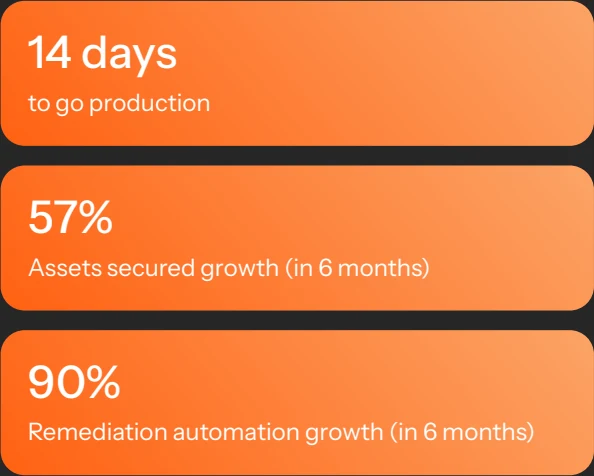
Once assets and exposures are prioritized, Axonius customers immediately adopt enforcements, workflows, and case binding for both validation and mobilization. (On average, customers grow these actions in about 90% over the 1st 6 months)
Read the full section
- Deployment in Hours
- 1,000+ pre-built Integrations
- No agent or network proxy required
- Connects to Solutions Using Adapters
Through the Axonius integration network and adapters that do not require agents or network proxies, you can quickly integrate with all your systems to find assets and exposures very fast.
On average, Axonius customers take 14 days to go into production with continuous growth across assets, automation, and return on investments.
The Axonius adoption steps align directly with the five steps of the CTEM approach.
With scoping and discovery running continuously from day one, Axonius implements a repeatable process foundational for establishing and improving your CTEM approach, building a virtuous cycle. This continuous approach provides many organizations a linchpin for their security strategy.
Which sources does the guide cite?
Axonius documentation pages, four public vulnerability resources, and research from Gartner and Forrester.
Read the full section
Axonius’ documentation
- Axonius Adapters
- Axonius Adapter List
- Asset Types
- Discovery Cycle
- Discovery Schedule Settings
- Real-time Adapters
- Discovery retention
- Vulnerability Enrichments
- NIST National Vulnerability Database (NVD)
- CISA Known Exploited Vulnerabilities (KEV)
- Exploit Prediction Scoring System (EPSS)
- Microsoft Security Response Center (MSRC)
- Queries
- Dashboard Templates
- Enforcement Actions
- Enforcements
- Workflows
- Axonius Exposures
- Vulnerability Instances
- Risk Scoring
- Publicly Exposed By
Other references
- Continuous Threat Exposure Management (CTEM): A Guide to Proactive Cybersecurity
- Ditch the Checkboxes: A Guide to Risk-Based Vulnerability Management
- Is CTEM the New Zero Trust, virtual webinar
- How To Strengthen Vulnerability Risk Management With Remediation Prioritization, Forrester
- How To Implement a Risk-Based Vulnerability Management Methodology, Gartner, 20 April 2023
- The Top 5 Elements of Effective Vulnerability Management, Gartner, 9 January 2024
- Implement a Continuous Threat Exposure Management (CTEM) Program, Gartner, 11 October 2023
GARTNER is a registered trademark and service mark of Gartner, Inc. and/or its affiliates in the U.S. and internationally and is used herein with permission. All rights reserved.
Which Axonius features serve each step?
Twenty-four features map to the five steps; Queries and External to Internal serve four steps each, more than any other feature.
| Axonius feature | Scoping | Discovery | Prioritization | Validation | Mobilization |
|---|---|---|---|---|---|
| Adapters: Assets | Yes | ||||
| Adapters: Vulnerabilities | Yes | ||||
| Adapters: Cloud Exposures | Yes | ||||
| Adapters: Application Development Exposures | Yes | ||||
| Adapters: Tickets | Yes | ||||
| Adapters: Threat Intelligence | Yes | ||||
| Adapters: Breach Attack Simulation | Yes | Yes | Yes | ||
| Asset Types | Yes | ||||
| Discovery: Logic/lifecycle | Yes | Yes | |||
| Discovery: Continuous Discovery | Yes | Yes | |||
| Discovery: Real-time Discovery | Yes | Yes | |||
| Discovery: Retention | Yes | Yes | |||
| Static Analysis and Enrichments | Yes | Yes | |||
| Exposures | Yes | Yes | |||
| External to Internal | Yes | Yes | Yes | Yes | |
| Unified Context | Yes | Yes | |||
| Queries | Yes | Yes | Yes | Yes | |
| Dashboards | Yes | Yes | |||
| Dashboard Templates | Yes | Yes | |||
| Risk Score | Yes | Yes | Yes | ||
| Enforcement Actions | Yes | Yes | |||
| Enforcements | Yes | Yes | |||
| Workflows | Yes | Yes | |||
| Case Management and Ticket Binding | Yes | Yes |